Showing posts with label James Eads. Show all posts

Saturday, March 3, 2018

52 Ancestors in 52 Weeks - Week 9

The writing prompt for this week is Where There’s a Will. This was a tough one for me as I have very few ancestors for whom I have been able to locate a will. The one will I did find was for Josephine (Hillenbrand) Ashton, my 2nd great-grandmother, and I wrote about her and the will in a previous blog post, which can be found here.

Obviously the word will could be used to express determination, persistence or willfulness as well. I think my 3rd great-grandfather, Andrew Hungler, fits this description, as does his wife Malinda.

Andreas, known as Andrew, was born 22 November 1827 in Niederrimsingen, Baden, Germany to Lawrentz Hungler and Katharina (Willig) Hungler. He was the oldest of 4 children, 3 of whom were born in Germany. Early German and passenger records lead me to believe that the name was spelled Hunckeler or Hunkeler back in Germany. The family of 5 traveled from the port of Havre in Germany to the United States on the ship Orleans, arriving in New Orleans on 28 October 1833. From there they made their way to Cincinnati, Ohio, where Andrew’s younger sister was born.

Andrew married Malinda Harcourt in Cincinnati on 3 December 1848. The couple had 6 children, 4 of whom were born in Cincinnati where Andrew worked as a brick maker. The last two were born across the river in Covington, Kentucky.

On 19 August 1864, the 3rd year of the Civil War, Andrew enlisted as a seaman in the U.S. Navy. His commitment was for 2 years. He was 35 years old, 5’4” tall with hazel eyes and dark hair. The registrar indicated that he had a scar on his right foot. It is curious that he would have enlisted, first due to his own age (the average age of a sailor at that time was 25), but also because his children were 14, 9 and 6 years old, and his wife was 6 months pregnant with their 4th child.

USS Milwaukee
Andrew served aboard the USS Grampus from August 19-21, then on the USS Great Western from August 22-27, and then on the USS Milwaukee from 28 August 1864 until 14 April 1865. An interesting side note is that the Milwaukee was built by James Eads at Union Iron Works Carondelet in St. Louis. She was commissioned on 27 August 1864, and traveled from St. Louis down the Mississippi River.

On the Milwaukee Andrew’s military designation was quartermaster. His duties would have involved navigation and the maintenance, correction, and preparation of nautical charts. He began to experience pain in his legs while aboard the Milwaukee in December of 1864, and by the early part of 1865 he was limping and complaining of overall body pains. He spent time in the sick bay and was barely able to function in his job.

The ship entered Mobile Bay on 1 January 1865. Mobile Bay had been taken by the Union in August of 1864, but the city of Mobile was still in Confederate hands. The Milwaukee encountered a mine while in the area on 28 March 1865 and blew up, but was able to remain afloat. The crew managed to escape with no loss of life, and they were rescued by the USS Kickapoo. On another side note, scrap metal from the Milwaukee was returned to St. Louis, where it was used in the construction of a bridge across the Mississippi which bears the name of the builder, James Eads.
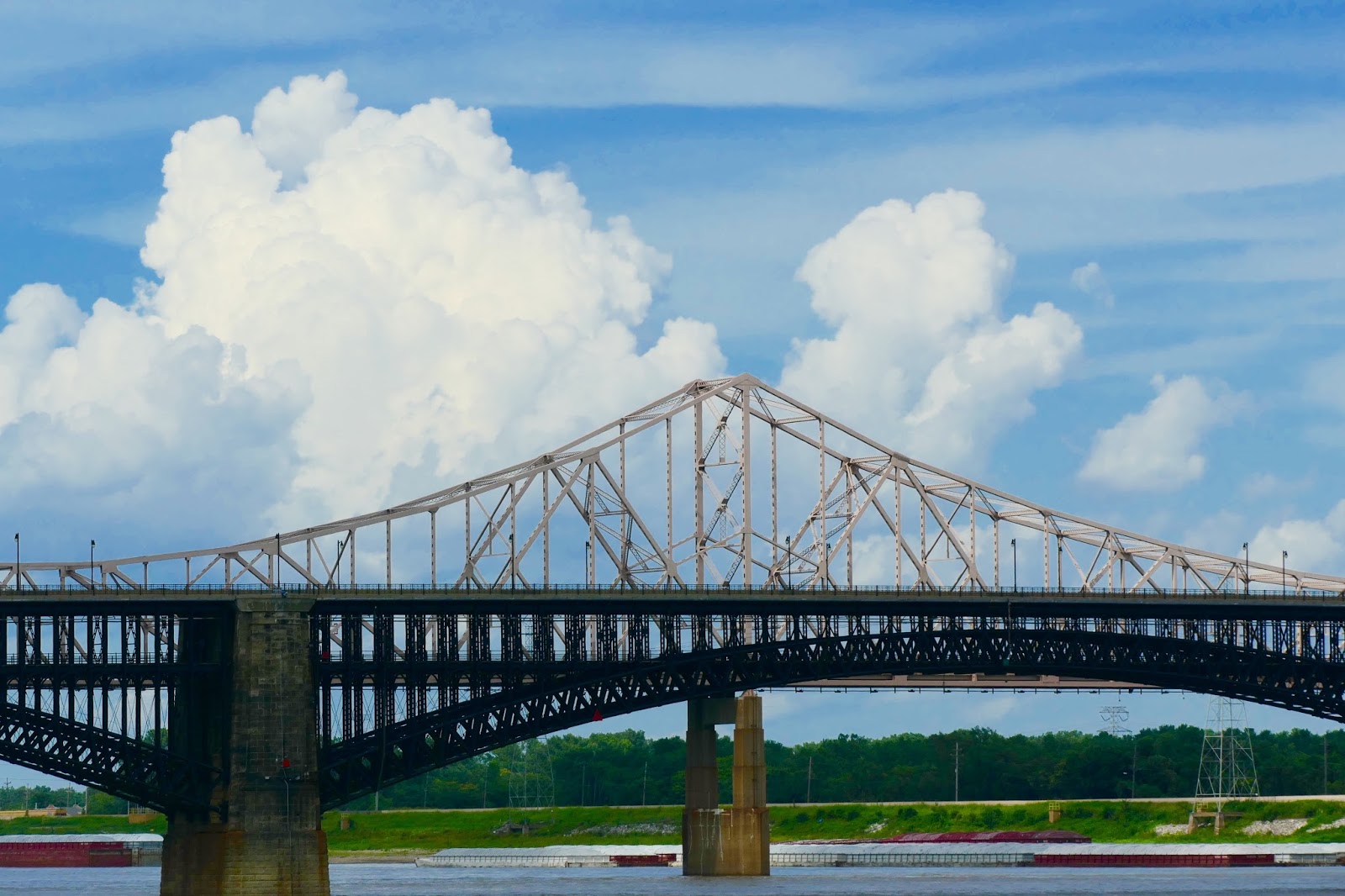
Eads Bridge in foreground

Following the loss of the Milwaukee, Andrew was transferred to the USS Rose, where he remained until 28 July 1865, when he was taken to a hospital in Mobile, Alabama. One can only hope that he was treated appropriately since he was with the Union and the hospital was in Confederate territory. He left the hospital after 3 or 4 weeks. At one point he was listed as a deserter, but once it was determined that he had been in the hospital, he was honorably discharged.

Due to health issues caused by his service he returned home to Covington in September of 1865, crippled and on crutches. He told his family and friends that he had contracted rheumatism while onboard the Milwaukee. The symptoms of the disease were certainly there, with pain, stiffness, and limited motion of joints. Once home, he needed to be lifted in and out of bed and could barely use the crutches as his legs, arms and shoulders were all crippled. He had to be dressed and bathed, and never recovered from his illness. This did not prevent him and Malinda from having another child in 1867, however.

Andrew died 3 May 1869 at the age of 41 following a week of being unable to leave his bed at all. For a month before he passed he had complained of pain in his heart and shortness of breath. His physician, Dr. Frank Noonan, listed heart disease brought on by rheumatism as the cause of death.

Malinda was 37 when her husband died, and her children were 19, 14, 11, 6, 5, and 2. She became a housekeeper to support the family, and was still working in that capacity when, on 26 November 1888, she filed for a Widow’s Pension for Andrew’s service in the military. As with many government applications, things did not move very quickly on her request. Finally, affidavits were filed in April of 1895 asking that the case be expedited as Malinda was feeble and destitute. Finally the government began taking depositions in the case, requiring testimony from Malinda and her surviving children, shipmates, doctors, neighbors and people who knew Andrew before and after his military service. It was not until 1896 that Melinda began to receive $12 per month as the widow of a sailor, and $12 per month for each child who was under the age of 16 when her husband died. In her case, 5 of the 6 children met that criteria. As Malinda died 11 December 1896, she certainly did not receive financial aid for very long.

Andrew was determined to serve his country in the Civil War, and it took a huge toll on his health and ultimately led to his death. His widow, Malinda, showed great persistence in keeping her family together and fighting for her rights as the widow of a Civil War soldier.

Thursday, February 12, 2015

Family History Writing Challenge Day 12

For two years John Murdoch handled the responsibilities of administering the Murdoch & Dickson partnership estate. But on October 14, 1873 he executed a deed of assignment of the partnership assets to John G. Priest for the benefit of creditors of Murdoch & Dickson. Through this assignment he undertook to convey to Priest as assignee all of his own property for the benefit pro rata of his individual creditors, and all of the property of the firm of Murdoch & Dickson for the benefit pro rata of the creditors of the firm. Subsequently in that same year, failing to obey an order of the court to give an additional bond as surviving partner, Murdoch was removed as administrator of the estate of Murdoch & Dickson. The Southwestern Reporter, in giving an overview of a lawsuit that was filed many years later, stated, "From the record facts before us, we have no doubt that the firm owed in excess of its assets and was insolvent."

James Eads and Barton Bates, as Trustees of the estate of Charles K. Dickson, were provided with the following accounting of the assets of the firm of Murdoch & Dickson. The amount of $93, 237.47 is shown, and a note below it states "subject to credits and debits." This was presumably provided to them by Priest.

Balance sheet of Murdoch & Dickson

John Priest, in the meantime, proceeded with his assignment, collecting assets, allowing claims, and disbursing moneys. Priest remained in the assignment capacity until 1888. At that time he applied for discharge from those responsibilities.

John Murdoch continued to work in the auctioneering business. A Tour of St. Louis or the Inside of a Great City by Joseph A. Dacus and James William Buel, published in 1878, had an accounting of the auctioneering firm of O.J. Lewis & Co.

In St. Louis there are several large auction houses, but the chief one among the many, representative of the West, is the immense house of O. J. Lewis & Co., No. 417 North Fifth Street. The present firm is the successor of Murdock & Dickson, who established business in 1836 at No. 204 and 206 North Main Street, at that time the center of the jobbing trade of the city, where they did a very large business. In the year 1873 Mr. O. J. Lewis purchased the entire interest in the concern, when the name of the firm was changed to its present title.

Because Murdoch & Dickson was in the process of liquidation, it would be interesting to know what, exactly, O.J. Lewis was able to purchase in 1873. Perhaps it was just the expertise of John Murdoch, as future city directories have him listed as working as an auctioneer with O.J. Lewis & Co. Lewis experienced great success with the business, moving it to a six story building consisting of twenty-seven thousand square feet.

While it must have been exciting to work for a company experiencing such growth, one can only imagine what it was like for Murdoch, who had always been his own boss, to no longer be the one calling the shots.

Wednesday, February 11, 2015

Family History Writing Challenge Day 11

St. Louis had a population of 310,864 residents in 1870, an increase of 93% over the 1860 census! It was now the fourth largest city in the United States, behind Chicago, Philadelphia, and New York. The next decade would show a continuation of impressive development in St. Louis. The City's limits reached 17.98 square miles, with a record high 58 subdivisions platted in 1870. Improvements in machinery caused industries to boom in North America, and St. Louis was no exception. This brought another influx of immigrants to the area, predominantly Germans and Irish. By 1870, Lemp Brewery was the largest brewery in St. Louis and controlled the lion's share of the market, and St. Louis became the first American city to legalize prostitution.

With the death of his business partner early in 1871, these things were probably of little concern to John Murdoch as he fought to save his business. Because Murdoch & Dickson was established as a partnership, the company dissolved on the day that Dickson died. On March 31, 1871, Murdoch qualified as surviving partner to administer the partnership estate in the probate court of the City of St. Louis. He posted a bond in the amount of $125,000, with James B. Eads and Barton Bates as sureties. (These same two men were handling the estate of Charles Dickson.) Shortly thereafter he filed an inventory of the assets of the business with the probate court.

Unfortunately, at this point in time the liabilities outweighed the assets of the company. Dickson himself was owed over $84,000 at the time of his death, and the firm was also indebted to James Eads in the amount of $34,000 and $5,000 to Barton Bates. The total indebtedness of the company was around $280,000. It is uncertain how the firm came to be in such dismal financial straights, but Murdoch was committed to trying to pay off the debt. This came at a cost to his personal financial situation.

On May 1, 1871 John and Julia Murdoch signed a Deed of Trust with Franklin A. Dick and Benjamin Farrar as parties of the second part, and Isaiah V. Williamson of the City of Philadelphia as party of the third part. Benjamin Farrar was an attorney and also Assistant Treasurer of the United States in St. Louis, and Franklin Dick practiced law in St. Louis as well. Isaiah Williamson owned a dry goods store in Philadelphia, and died a multi-millionaire in 1889. The purpose of the deed was to guarantee a $30,000 loan that was taken out on Murdoch Farm.  The loan was for a period of three years at an interest rate of 8%. Three parcels of land are outlined in the deed, consisting of 226.077 acres. One of the three parcels included the house where the Murdochs made their home and the farm's outbuilding. In the event that Murdoch failed to make a payment of the principal or interest, or to properly insure the property, the land was to be sold at public auction to the highest bidder.

John Murdoch was losing his business. Would he be able to hold onto his land?

Sunday, February 8, 2015

Family History Writing Challenge Day 8

St. Louis circa 1870, Murdoch & Dickson offices at #9 on map

The financial status of St. Louis was certainly impacted by the Civil War. The war years brought a cessation of river traffic, resulting in St. Louis being cut off from its traditional and most lucrative markets in the south. This in turn harmed the local businesses. The decrease in steamboat traffic particularly caused the downtown levy to decline in importance at St. Louis. After forty years of nearly uninterrupted growth, this was traumatic for the city.

Additionally, there were allegations of impropriety within the U.S. Army Quartermaster's office under the command of Justus McKinstry. His administration was accused of fraud and abuse, with local businessmen bearing the brunt of the corruption. As the firm of Murdoch & Dickson was engaged in supplying everything from clothes to shoes and boots to dry goods, it is highly possible that the firm was a victim of this deception. Their real estate investments would also be a problem due to the fact that the war brought a virtual halt to construction in St. Louis.

1867 Deed
The first inkling of trouble for the firm came in the form of a deed that was entered on May 29, 1867. Charles and Mary Dickson along with John and Julia Murdoch were the parties of the first part, and James Eads and Charles Stevens were parties of the second part. Party of the third part was Barton Bates. Murdoch and Dickson owed Bates $25,000, and they did not have the resources to pay him back. A lot in Block 89 of the City of St. Louis was conveyed to Eads and Stevens to be held in Trust on behalf of Murdoch and Dickson. If the $25,000 was paid to Bates in five, $5,000 notes plus 8% interest, then the land would convert back to Murdoch and Dickson. If the payments were not made, then the land would be sold by Eads and Stevens at auction to satisfy the debt.

James Eads was an important businessman in St. Louis, having arrived in the city was he was just thirteen years old. A self-taught engineer, he began his business life by rescuing wrecked boats and cargo from the Mississippi River. This proved to be lucrative as insurance companies would pay him a percentage of any recovered goods. He then put these skills to work constructing ironclad gunboats for the War Department during the Civil War. In 1867, he formed an organization dedicated to building a bridge across the Mississippi River in St. Louis. Charles Dickson was very instrumental in the organization, which is probably the reason that Eads got involved in this Deed.

But it is this quote from the 1991 book Yankee Merchants and the Making of the Urban West by Jeffrey Adler that offers the best explanation of why a firm with the successful record of Murdoch & Dickson discovered its foundation crumbling around it.


Would the firm be able to recover from the disaster encountered by the east coast investor?