Showing posts with label emigration. Show all posts

Wednesday, January 30, 2019

Wolterman Genealogy - Week 4

First, let me mention that the Woltermann families were members of the Lutheran Church in Germany. Their town of Stapelmoorheide was located in Church District V. To date I have been unable to identify which church they worshipped in. Perhaps it was the Cross Church in nearby Stapelmoor, which is one of the oldest churches in Ostfriesland.

Cross Church

Johann (John) Gerhard was the subject of last week’s post. This week I’ll be talking about his father, Gerrit Jans Woltermann. Gerrit was born 21 November 1792 in Stapelmoorheide, Ostfriesland, Germany to Jan Geerds Woltermann and Gepke (Boelen) Woltermann. His brother Jan was born 6 October 1797, and brother Hindertje about 1804 in the same town.

On 29 March 1829, Gerrit married Helena Jans Boze in Hannover. Helena was born in Brual, Emsland, Germany, which is 4 km from Stapelmoorheide but 260 km from Hannover. Why were they married in Hannover? The Cross Church in Stapelmoor would have been much closer since it was just 3.5 km away.

Gerrit and Helena set up their household in Stapelmoorheide, where son Johann (John) Gerhard was born on 24 June 1829. (Maybe they married in Hannover because Helena was 6 months pregnant at the time of their marriage?) Their daughter Antje was born 16 September 1832. Antje married Johann Eugene Williams around 1852, and they had three sons: Wilhelm born in 1853, Heinrich born in 1857, and Johann born in 1862. Unfortunately, Antje died on 23 October 1865 at the age of 33.

Gerrit and Helena made the decision to leave their homeland in 1869. His brother Hindertje had died in 1828, and his brother Jan in 1859, With the passing of their daughter Antje in 1865, perhaps they felt there was nothing keeping them in Germany. Especially since their son Johann had emigrated with his family in 1868.

When Gerrit and Helena left Germany, their daughter's three sons accompanied them. I have no information on whether Antje’s husband Johann was still alive at that time or not. He was not listed as being on the ship with them. Gerrit was 77, Helena 70, Wilhelm 17, Heinrich 12, and Johann 6. They traveled aboard the bark "Olbers".

bark Olbers
A bark (or barque) is a sailing ship of three or more masts, having the foremasts rigged square and the aftertaste rigged fore-and-aft. The journey from Germany to the United States on one of these sailing vessels could take anywhere from five to eight weeks, depending on the winds and weather. Passengers typically had to bring their own food, bedding, and pots and pans. Due to close living quarters and poor sanitary conditions, travel for the elderly and children was particularly hazardous.

The "Olbers" was named for Heinrich Wilhelm Matthias Olbers (1758-1840), who was a famous physician and astronomer from Bremerhaven. It was built by J.C. Tecklenborg in Bremehaven and delivered to its owner, a shipping company named D.H. Watjen & Co., on 23 May 1863. Its gross tonnage was 894, the length was 151.5’, the beam was 32.1’ and the draft was 20.8’.

Herman Dieke was Master of the "Olbers", which sailed from the Port of Bremen to Baltimore, Maryland. There were 392 passengers on this particular passage. In notes that were transcribed by the Immigrant Ships Transcribers Guild, it is noted that the Woltermann family was from Stapelmoor, Ostriesland, and that the three children were the grandchildren of Gerrit. It also states that Helena was the second wife of Gerrit, and that her maiden name was Boose/Boze. So far I have seen no records to indicate that Gerrit was married prior to his 1829 marriage to Helena. Most importantly, it is also recorded that Gerrit died on the journey and was buried at sea.

The "Olbers" arrived in Baltimore on 20 July 1869. Helena somehow got herself and the three children from Baltimore to Forreston, Ogle, Illinois where her son Johann (John) and his wife Anna and their children had been living since leaving Germany the previous year. In the Forreston 1870 census, Helena was in the household of John and his family, and so was her grandson Johann. I have found her other grandson Wilhelm living with another family in Forreston as a hired hand, but I don’t know where Heinrich was residing. He would have only been 13 at that time. In the 1880 census Heinrich was living with brother Wilhelm and his family in Forreston, and Johann was a farm hand living with an unrelated Forreston family.

By 1880 Johann (John) and Anna had moved to Carroll County, Iowa and Helena went with them. She died after 1880, probably in Wheatland Township, Carroll, Iowa. It is unclear where she was buried. I do not see a burial listing for her at Saint Bernard Cemetery in Breda, which is where her son and some of his family were laid to rest.

Wednesday, January 23, 2019

Wolterman Genealogy - Week 3

My husband’s paternal great-great-grandfather was Johann (John) Gerhard Woltermann. As mentioned previously, the name was spelled Woltermann in Germany. That is also the way it was spelled on the ship manifest when the Woltermanns emigrated in 1868. But the family seemed to drop the second “n” in America.

John was born 24 June 1829 in Stapelmoorheide, Ostfriesland, Germany to Gerrit Jans and Helena (Boze) Woltermann. He was baptized 28 June 1829 in Stapelmoorheide. John’s sister, Antje, was born in 1832.

Anna and John with family ~1886
On 6 May 1856, John married Anna Klaasen in Stapelmoorheide. He was 26 years old, and Anna was 21. Their first four children - Helena, Gerhard, Peter, and Gertrude - were born in Germany, while the last two - Anna and John - were born in the United States. I discussed their emigration to America in 1868 in the previous post, which can be found here. John was 39 and Anna 34 when they made the journey. The children were 11, 9, 6, and 1.

In the 1870 census, John and his family were living in Forreston, Ogle County, Illinois. John is shown to be employed as a carpenter. His 72 year-old mother Helena was living with them, as well as Anna’s mother Gertrude Peters, age  62. It is interesting that while I found a birth record in Germany for Anna Klaasen that lists Gertrude Peters as her mother, no father was indicated on the record. The fact that her name is listed as Gertrude Peters could mean that she never married Anna's father.

John and Anna's daughter, also named Anna, was born in Illinois about 1874. Their son John was born in Carroll County, Iowa in 1876. Obviously they moved from Illinois to Iowa between 1874 and 1876.

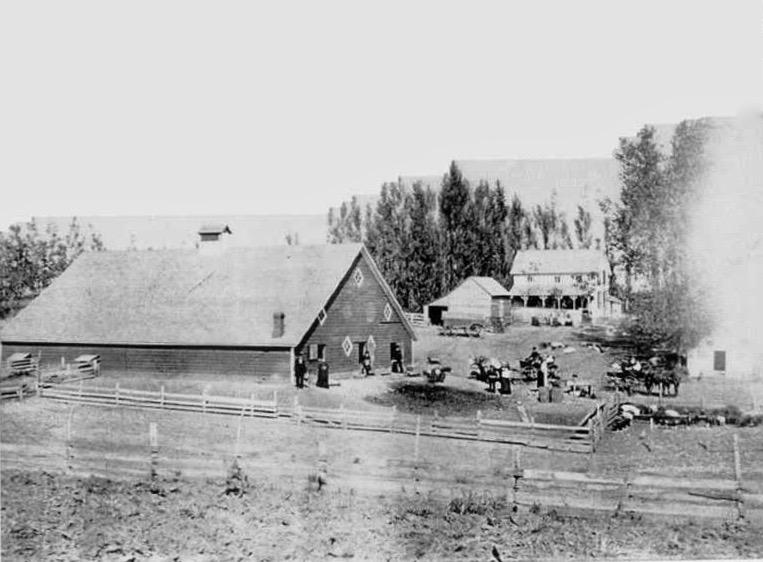
In the 1880 census the family was living in Wheatland Township, Carroll County, Iowa, where John was farming. His mother, Helena was still living with them at this time, but his mother-in-law was not. This is the only census that their daughter Anna appears in as she was born about 1874. Since she is not in the photograph above and I cannot find any other records on her, I'm guessing Anna died sometime between the 1880 census and the time this picture was taken.

John and Anna's farm in Iowa

Anna died 31 October 1901 in Breda. She was 67 years old. John died at the age of 78 on 30 November 1907, also  in Breda. They are buried in Saint Bernard Cemetery in Breda.

Anna and John's graves

Thursday, January 17, 2019

Wolterman Genealogy - Week 2

Last week I wrote about Frank Conrad Wolterman, my husband’s paternal grandfather. This week Frank’s father, Gerhard (George) Wolterman is the topic of discussion. George was the son of Johann (John) Gerhard and Anna (Klaasen) Wolterman, and he was born 18 December 1859 in Stapelmoorheide, Ostfriesland, Germany. He was baptized 19 December 1859 in Weener, which is 6.7 km from Stapelmoorheide.

George’s siblings included: Helena Maria born in 1857, Peter Johannes born in 1862, Gertrude Mary born in 1867, Anna born in 1874, and John born in 1876. The first 4 children were born in Stapelmoorheide, and the last 2 were born in the United States. The family name was spelled Woltermann in Germany.

Stapelmoorheide, Germany

Ostfriesland is an area in the northwest corner of Germany on the North Sea coast. It is located within Germany’s second largest state, Lower Saxony. Stapelmoorheide, in the County of Leer, is about 526 km west of Berlin, and 129 km west of Bremen. It was and is a small rural community. Nearby Stapelmoor was combined with Stapelmoorheide in 1974.

John, Anna and their children emigrated to the United States in 1868, arriving in New York City on 10 April aboard the ship “Manhattan”. It is interesting that they departed from Liverpool, England instead of much closer emigrant port of Bremerhaven. Perhaps the fare was cheaper from Liverpool, but it would be interesting to know how they got from their hometown to Liverpool.

The “Manhattan” was a steamship built in 1866 by Palmer’s Shipbuilding & Iron Co. at Newcastle, England. It had 3 decks, an iron hull, inverted engines, a speed of 10 knots, and accommodated 72 First Class passengers, and 800 Third Class passengers. The passage from Liverpool to New York averaged 14.7 days.  The captain of the ship was James Williams. John’s occupation was listed as Laborer.

Steamer Manhattan

From August of 1855 until April of 1890, immigrants arriving in New York were processed through the Emigrant Landing Depot at Castle Garden. Over 8 million immigrants came through this center during that time period, most of whom were from Germany, Ireland, England, Scotland, Sweden, Italy, Russia, and Denmark. More than 1 in 6 native-born Americans are descendants of the 8 million who entered the United States through Castle Garden.

Castle Garden, photo from National Archives

The Wolterman family first settled in Forreston, a small village in Ogle County, Illinois, but by 1874 they were living in Wheatland Township, Carroll County, Iowa where they had a family farm. On 6 February 1883, George married Catherine Woerdehoff in Breda, Carroll County, Iowa. George was 23 years of age and Catherine was 20. On the Wheatland Township land map from 1906, which I have enlarged below, you can see that the Wolterman land was adjacent to the Woerdehoff farm, so perhaps that is how George and Catherine met. George's brother Peter also owned a nearby farm.

Wheatland Township 1906

Wolterman land 1906

Catherine and George Wolterman
George and Catherine had the following children: Margaret born in 1883, John Alvis born in 1885, Anna C. born in 1886, Gertrude born in 1888, Catharine Margaret born in 1889, Gerhard Jacob (George) born in 1891, Bernadine born in 1893, Peter J. born in 1895, Leonilla Mary born in 1898, Frank Conrad born in 1899, Clara Helena born in 1901, Edmund J. born in 1903, and Albin A. born in 1907.

George continued to farm until his death on 31 March 1921. He was 61 years old. By the 1930 census, Catherine owned a home valued at $1,800 in the town of Breda. She was living next door to her daughter Catherine Margaret Ocken. Catherine died 15 August 1935, and she and George are both buried in Saint Bernard Cemetery in Breda.

George and Catherine Wolterman graves


Saturday, January 27, 2018

52 Ancestors in 52 Weeks - Week 4

Week 4 of the challenge asked the question, "Which ancestor would I most like to invite to dinner?" My answer is Barbara Karch Metz, my maternal second great-grandmother. I’ve had a great admiration for her ever since I learned that following the death of her husband in Germany, she boarded a ship with 6 of her children and headed to America. Here is her story.
Insheim, Germany
Insheim Catholic Church
Born in Insheim, Rheinland-Pfalz, Germany to Johann Joseph March and Maria Barbara Pfalzer on 29 March 1820, Barbara was the oldest of four girls. At the age of 21, she married Joseph Henry Metz on 16 February 1842 at the Catholic church in Insheim.

Barbara and Joseph had nine children, all of whom were born in Insheim: Nicholas b. 1842, Anna Maria b. 1843, Barbara b. 1846, Elizabeth b. 1849, Magdalena b. 1852 and died 1852, Joseph b. 1853, Rosina b. 1856, Johannes b. 1859, and Peter b. 1862. On 27 September 1862 Joseph Henry Metz died, reportedly from a bee sting. He was only 43, and my great-grandfather Peter was just four months old.

SS Borussia
By the next year the two oldest daughters, Anna Maria and Barbara, emigrated to the United States on the SS Borussia, a sailing vessel in the Hamburg-American Line. The ship arrived in New York on 15 July 1863. The sisters then made their way to Cincinnati, Ohio, possibly because their father’s brother, Adam Metz, was living there with his family.

SS Arago, sister ship to the SS Fulton
photo from US National Archives
In 1866, Barbara and her remaining 6 children traveled from Insheim to Le Havre to board the SS Fulton, a paddle-steamer in the New York & Havre Company line. The journey would have taken around 14 days. Barbara was 47 at that time, and her children were the following ages: Nicolas-24, Elizabeth-18, Joseph-9, Rosina-7, Johannes-5, and Peter-3. From New York, Barbara and the children made their way to Cincinnati.

Family lore has it that once Barbara and her family arrived in Cincinnati, they did not know where to go. So they all gathered around a Metz meat truck, hoping to get assistance. This Metz was not related to her deceased husband, but it was a name she recognized. I’m not sure if there is any fact to the story, but it is a fun one nonetheless.

Barbara was 73 when she died in Cincinnati on 29 April 1893.

If I had an opportunity to dine with Barbara, I would ask her about her husband Joseph’s death, and how the family survived in Insheim for nearly four years without him. I would want to know what it was like to leave the only town she had ever known, and what relatives were left behind. What was the voyage by ship like? How did they get to Cincinnati from New York - train? What did she think of her new country when she arrived in Cincinnati? Did they really sit by a Metz’s meat truck hoping someone could direct them in their new city? And finally, I would want to tell her how amazing I think she was for giving up her life in Germany to hopefully provide her children with a better life in the United States.

Monday, February 6, 2017

Family History Writing Challenge Day 6

America
The lyrics from Neil Diamond's song "America" seem to be torn right out of the minds and hearts of the immigrants who came to the United States seeking a better life for their families. They brought their dreams, seeking the light of freedom being offered here. Many of them came to parts of this country where other family members or neighbors had settled. Others sought out the parts of America that in geography reminded them of their homeland.

In the first half of the nineteenth century, large numbers of Swiss immigrants settled in the rural Midwest, particularly Ohio, Indiana, Illinois and Wisconsin. Cincinnati, Chicago and St. Louis were popular destinations. Immigrants who entered the United States through the port of New Orleans could take a riverboat up the Mississippi River to reach their final destination.

German-speaking immigrants continued to come to Ohio in large numbers after 1850, and set the cultural tone for many communities throughout the state. During the 1800s, they were the largest group of immigrants in Ohio. Cincinnati, in particular, was strongly influenced by its German population.

Cairo
If the Kübler family arrived at New Orleans after they left Switzerland, then it is possible that they traveled by steamboat up the Mississippi River to the area that is now known as Cairo, Illinois. Though Cairo wasn't officially founded until 1858, there was a small settlement in this area at the confluence of the Mississippi and Ohio Rivers. From this confluence, the steamboats could continue their journey up either river, and the Küblers could have traveled up the Ohio River to Cincinnati.

Cincinnati
The first physical evidence of the Kübler family in the United States comes in the way of the 1860 federal census. Enumerated on the 6th of June, Vinzenz is now known as Joseph and lists his wife Caroline and sons John, Adloch and Joseph in the household. The family lived in the 8th ward of the city of Cincinnati. Names in census records are often spelled incorrectly, and many immigrants anglicized their names in their new country. The umlaut was dropped from the last name, though some of the descendants would later spell their last name Kuebler instead of Kubler. The ages of the inhabitants of this house match the family. Joseph Kubler is employed as a chair maker, and his oldest son John is an apprentice in the same trade. The family, from all appearances, was settling into life in Cincinnati.

Sunday, February 5, 2017

Family History Writing Challenge Day 5

Generally when a Swiss citizen applied for a passport in the 1800s, it meant that they would soon be leaving the country. As Vinzenz made his application in February of 1854, it is assumed that he sought passage to America that year. From a death notice of Joseph Kübler, son of Vinzenz and Carolina, it is mentioned that the family entered the United States through the port of New Orleans. As the notice also contained an incorrect birth year for Joseph, and stated that he came to the United States in 1852, the accuracy of entry to the country via New Orleans is suspect.

Many of the passenger records from New Orleans have been lost or destroyed, so to date a listing of the family has not been located, despite looking at surviving records from 1850-1859. However, if the family did indeed arrive through New Orleans, then it is possible that they sailed from the port of Le Havre in France. The distance from Büsserach to Le Havre is less than what the family would have needed to travel to sail out of the ports in Bremen or Hamburg, Germany. Even then, the distance they would have traveled to Le Havre exceeded 476 miles. The train system in France, particularly in the eastern part of the country, was not fully developed.

Büsserach
The family would also have had the choice of traveling 506 miles to the port of Bremen, or 521 miles to the port of Hamburg. Even with the more advanced rail system in Germany, it would not have been an easy or direct trip for them. Most likely they would have traveled with just their clothes and perhaps a cherished personal item such as a bible due to the limited amount of space they would be allowed on the ship. Vinzenz and the rest of the Küblers would have told their families and friends good-bye, knowing they would most likely not see them again. Perhaps they took one last walk around the village to bid farewell to the only life they had ever known.

Once they arrived at their port of call, it might have been days or weeks before their scheduled ship arrived in port. In the meantime, emigrants were subjected to physical exams, including eye exams, to ascertain if they were fit for the voyage.

Until the 1860s the majority of the ships were sailing ships. Many immigrants sailed on packet ships, which were vessels designed to carry mail, cargo and people. (Even when steamships began to accommodate passengers, many immigrants traveled by sailing ships due to the differences in cost.) It would have taken over a month for the immigrants to travel from Europe to America. If the Küblers traveled from Le Havre, the cost would have been around 80-100 Swiss francs, depending on the number of passengers on the ship. Food could be purchased separately for around 40 Swiss francs, and might have consisted of biscuits, flour, butter, ham, salt, potatoes and vinegar. The steerage passengers would then prepare their own meals. The Kübler family would have also had the additional expense of transportation to Le Havre, which might have run about 60 Swiss francs. Of course, all of this is assuming the emigrants enlisted the aid of a reputable company. An unscrupulous one would result in extremely poor conditions on board the ship, along with insufficient provisions.

The passengers in steerage slept in narrow, closely packed bunks below deck. The cramped living quarters meant there was little privacy, and illnesses were easily spread. In nice weather, they might have been allowed to go up on deck to get some fresh air. In poor weather conditions, they were stuck below.

Vinzenz did not bring his mother along when he left Switzerland. Perhaps she was in ill health and unable to make such an arduous journey. Whatever the reason, it must have broken Maria Anna's heart to lose her final son and his family - this time to a new world. Meanwhile, she remained in Büsserach where she would live the rest of her life in one room of the house that had once been hers. Swiss law was such that when a home was sold, the widow was allowed to remain there in a designated room until she died. Did she know the family that purchased the farm? Was it awkward to know she was essentially a guest in her own home?

Saturday, February 4, 2017

Family History Writing Challenge Day 4

Swiss cow
While the Kübler family was fortunate to own land in Büsserach, that did not mean life was easy for them. The climate and the soil in that part of Switzerland were not particularly great for agriculture. The hills and mountains made it more suitable for cows and goats than growing crops, and there was insufficient land to accommodate a growing population. Perhaps a crop failure in 1853 was the final breaking point for Vinzenz, and the motivation to uproot his family and start all over again in America. He certainly wasn't alone in his thinking.

Between 1851-1860, over 25,000 Swiss emigrated to the United States. Generally speaking, it is not the richest inhabitants of any country who seek a home elsewhere. This is particularly true in Switzerland, where the love of country is so strong that only absolute necessity could tempt people to leave their native villages. The majority of the emigrants came from the agricultural cantons. They often traveled with groups coming out of their same region. In some areas the local council gave them a financial incentive to leave so they would have less citizens to feed during times of economic recession. The money was given to the emigrants on the condition that they never return to Europe, and with the caveat that if they did return, the money was to be repaid with an interest rate calculated on top of it.

Advertisements were placed in Swiss newspapers by travel agencies who catered to the demand for emigration. Some were reputable, and some took advantage of the poor Swiss who were enticed by the offers of cheap and fertile lands in America, or the opportunity for higher wages and better opportunities for work. The agencies of ill repute were referred to as Seelenverkäufer and Bauernfänger (soul-sellers and peasant-catchers). Eventually the Swiss government stepped in to supervise the travel agencies in an effort to protect its citizens.
Kübler passport
Whatever his motivation, on 8 February 1854 Vinzenz applied for a passport to America. He had sold his part of the family farm, conducting the deal at the very building pictured below which was located in nearby Breitenbach. The sale is how he financed the trip for his family. Using the name of Josef Kübler, the passport indicates that he was from Büsserach and was 41 years of age, 5'7" tall, with black hair, grey eyes and an oval face. It states that he was a farmer and would be traveling to America with 4 children. It is notable that his wife Carolina is not included on the passport. There is no death record for her in Büsserach, and in fact she appears in records in America. It's possible that there was an oversight, or perhaps she traveled at a later time period.

Landgasthof Weisses Kreuz
Where did the family go? And what was to become of Vinzenz's mother, Maria Anna?