Showing posts with label class. Show all posts

Monday, November 10, 2014

Publishing Your Own Book

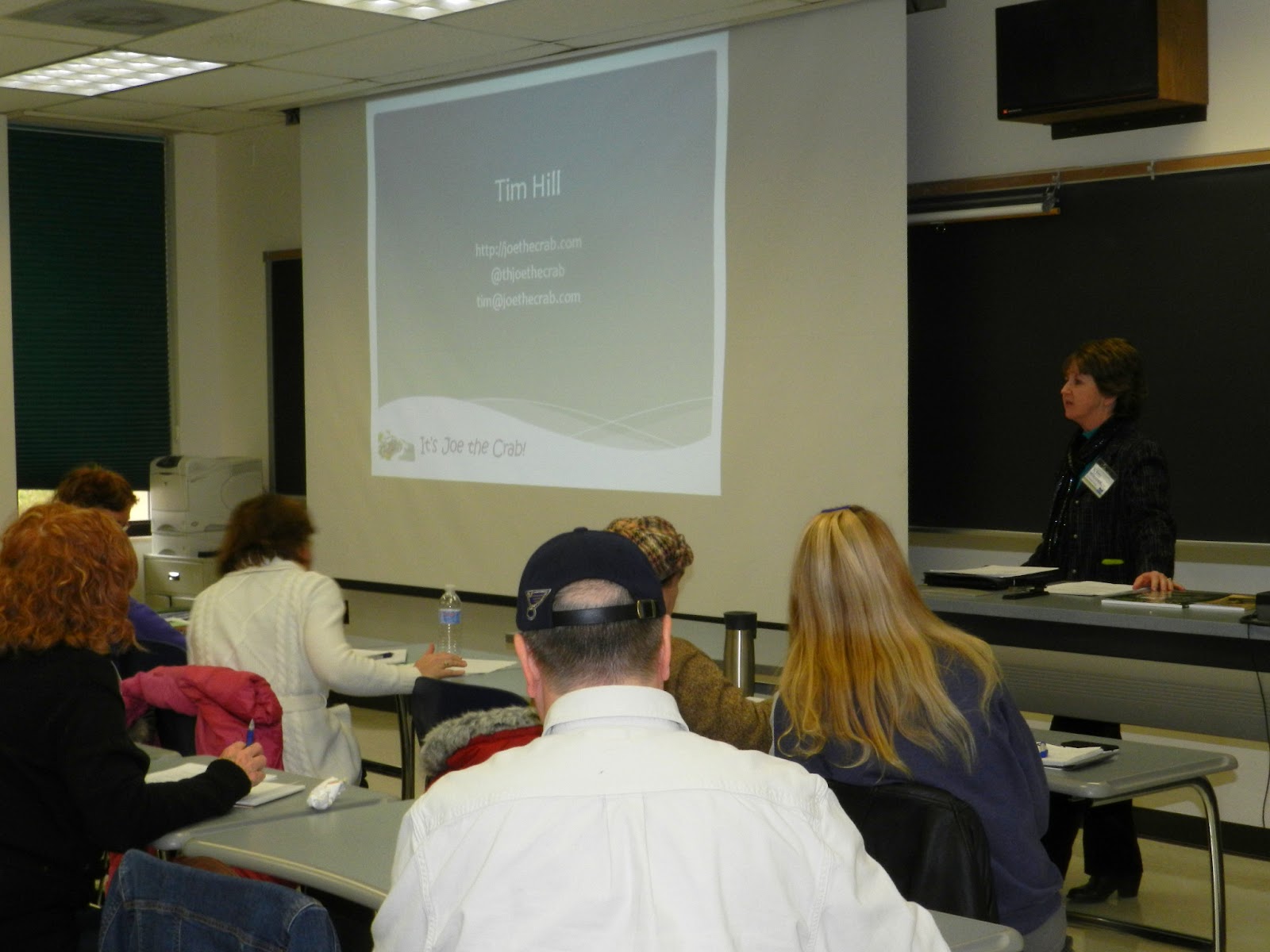
Kim Wolterman kicks off the class
The St. Louis Publishers Association (SLPA) offers a book publishing class through our local community college once or twice a year. I usually organize the class and then serve as the moderator, also throwing in my two cents worth when warranted. Our most recent class was a full house, with thirty writers signed up. I like to ask each person to give their name and a short sentence or two on what they are writing about before the class gets started. I think it is fun to see the genres people are writing about, and it also offers an opportunity for folks to connect with other attendees who might be writing about a similar topic.

Over the course of four hours we cover traditional versus independent publishing, getting your book into print, book design, ebooks and how to get your book into the marketplace. It is a lot of material to cover in the short amount of time we have, but the purpose is to give an overview of the whole process of what to do once you have written your book. From our perspective as an organization, we want to make sure that authors know about our monthly meetings. All of the topics covered in the class, and more, are discussed throughout the year. For all of us, the SLPA was the place where we learned what to do next and made the connections to get the steps done. If you are a writer, check to see if there is a publishers association in your area. The help and support you receive will be invaluable.

Monday, April 28, 2014

Who Inspired You to Write?

Writing is something that I have enjoyed doing for as long as I can remember. I liked the writing assignments in school, and usually thanked God for the essay questions on tests as they almost always brought my scores up. And I was one of those weird kids who actually loved to diagram sentences. The English programs in both my junior high and senior high schools were very strong, and I had some excellent teachers along the way.

Jerry Wadden
Most memorable, though, was Jerry Wadden. Mr. Wadden taught A.S.P. English, which I took my senior year in high school. It was an advanced placement class, and I will never forget the first day in his classroom. He laid down the law about how hard the class would be, the number and difficulty of the assignments we would be required to complete, and the rules of his classroom. A number of students immediately dropped the class, and I am not going to lie - I considered doing so myself. After all, it was senior year. Did I really want to work so hard for a class that was not even required for graduation? Obviously, I stuck with it, and it was one of the smartest decisions I ever made in my educational process.

While the class did require a lot of work, it truly made us think and question as young nearly-adults. And my writing skills grew exponentially in his class. Mr. Wadden was a fair teacher, but he pushed us to be critical thinkers and writers. And he was very supportive of those of us who were going on to college.

A year or so ago a classmate gave me Mr. Wadden's email address, and we have since been corresponding. He remembered an impressive amount of information about me, including where I had been planning to go to college and what I was going to major in. Surely he must have kept note cards on his students? I was grateful to have the opportunity to be able to thank him for the impact he has had on my life. He was not surprised that I have authored books and have my own publishing company.

My 40th class reunion is this summer, and I have invited Jerry (as he insists that I call him - it still feels awkward to do so) to join us. He is planning to attend, and I can't wait to see him. There are some things that are better expressed in person. My speech teacher Mr. Springer will be there as well. He is another man who shaped the type of college student and later employee that I would become. I owe him a thanks as well.

Who inspired you to write?

Tuesday, March 5, 2013

Getting Your Book Published

Kim Wolterman, Getting Your Book Published
On Saturday the St. Louis Publishers Association held a four hour workshop on what authors need to know about publishing. Held at the St. Louis Community College Meramec Campus, the course covered traditional versus self-publishing, getting your book into print and the marketplace, making your book look good from a design standpoint, eBooks and book marketing. We had 27 attendees of all ages and writing backgrounds, and they certainly had a lot of wonderful questions. It is always fun to hear what other people are writing about, and this group was no exception. I am hoping that we see some of them at future St. Louis Publishers Association meetings!

Wednesday, March 7, 2012

I Have No Class

Unfortunately there was insufficient registration for my spring class on Writing, Publishing and Promoting a Non-fiction Book at the community college. The director said that none of the non-fiction classes did well, while the fiction classes were all full. She said it swings like that sometimes. I am disappointed, but on the other hand I wasn't sure I was going to have a book for the class so it may be just as well. I'll have time to look at book options for the fall, or perhaps even write my own workbook for the course.

Because I was on vacation last week I was not able to write anything for the Family History Writing Challenge from February 25th until it ended on February 29th. I am really glad that I participated in the challenge though as I learned a lot from Lynn, who put it all together, as well as the other members who submitted in the forum that was set up for us. Thankfully Lynn is keeping the forum open, so I hope that we can keep in touch. One thing the challenge motivated me to do was really examine what I have in the filing cabinet and three ring binder on my mom's side of the family. Doing the writing helped me to see what questions remain unanswered. I now have a nice list of items I want to cover with my aunts and one of my cousins when I go to Cincinnati this spring for the NGS annual conference. It does seem like such a waste to keep all of my research hidden in the file drawer. I might as well put it all into a book for my relatives to enjoy.

Saturday, February 18, 2012

Class-less in St. Louis?

Thursday I contacted the woman in charge of continuing education at the community college regarding a question I have about my class. The course description indicates that the students receive a workbook as part of their registration fee. In fact over the years the workbook has evolved into an actual paperback book on writing, publishing and promoting a non-fiction book. In the past the author of the book has simply invoiced the college $10 per book, and the instructor passed the books out.

However the author has a new edition of the book out, and it retails for $20. She can no longer afford to sell the books to the college at $10 per book. But the college didn't know this when the course catalog went to press. In fact I didn't know this until a couple of weeks ago. The woman from the college is going to contact the author to see if they can come to an arrangement. If they cannot, I am not sure what will happen. The course follows that book exactly, so it would be hard to teach without it. And I certainly cannot come up with my own workbook in two weeks. But it may all be a moot point. The class so far only has three people registered, and the college requires six in order to hold the class. I will call the woman back on the 24th to see what the registration looks like. At this point if I don't have a book available, I hope there are not enough registrants so I can re-group before the fall semester.

Thursday, November 3, 2011

A Touch of Class

Well, I have made the commitment to teach the Writing, Publishing & Promoting Your Non-fiction Book class for the spring session. I did make a few changes. First of all the class will meet on Monday nights at Hixson Middle School. I wanted to get the class off of Wednesday nights since it conflicts with the St. Louis Publishers Association meetings. The students need to be able to attend the meetings, and since I will be the Membership Chair I have to be there to check people in. Second, I figured if I was teaching the class again I might as well hold it at the school closest to me. Besides, I didn't really like being in the basement of Clayton High School.

The other thing I did was change the class description. Since the time I had taken the course it had been modified to reflect two tracts being taught simultaneously. Even after teaching this semester I didn't quite get what that meant, so I modified the description to reflect what I believe people will take away from the class.

At the last class I had handed out evaluation forms for the students to complete since Meramec didn't provide me with any. Based on the feedback I received, which was overwhelmingly positive, I will also make some tweaks to my weekly classes. I was so happy that everyone thought the guest speakers were helpful. I think that they add a lot to the learning process as they are all experts in their fields. Plus they offer a different voice and perspective from mine, which is beneficial.

I put some feelers out with the continuing education coordinator as to the possibility of offering a two hour Saturday workshop on how to research the history of your home. I could offer my house history book as part of the class. The coordinator was very amenable to the idea, but I would have to get a class description and the suggested class fee to her by tomorrow morning as they are getting ready to go to press with the spring catalog. So I decided not to rush into this, but will look at teaching it in the fall instead. I will be attending a house history talk through the St. Louis Genealogical Society in a couple of weeks, so that will help me with the format and pricing of the workshop. The biggest issue is where the workshop will be placed in the community college catalog. Their categories are Professional Development (which this is not), Lifelong Learning (which covers classes such as history, languages, personal computing, science and math), and Personal Interest (which covers activities for kids and adults, crafts, dance, fine arts, genealogy, music, photography, writing). The coordinator suggested placing it under history, which I can see. But I could also make a case for putting it under genealogy, not that it is the best option but genealogists do research the houses of their ancestors. I'm concerned that neither of those options will get a glance from my target audience. Lots to consider here...

Friday, September 23, 2011

My Students are Awesome!

Wednesday night's class was just amazing! Fifteen of my sixteen students came back, so I guess I did okay last week on my first night of teaching. Their homework was to read a certain portion of the textbook, come up with a sentence to describe their book, and try to answer ten questions in the textbook that are a precursor to writing a book proposal. All but one of the students in attendance had a sentence composed, and eleven of them answered the ten questions. I am so proud!

Going through each person's sentence took a large chunk of the class time, surprisingly. Everyone was great about asking for clarification on the topic and offering suggestions on how to tighten up or improve the sentences. It was really great feedback, so I hope the students found it to be beneficial. We also covered ways to organize your writing both on and off the computer, and covered the principles behind a well-written book proposal.

One of the questions that came out of this week's class is whether or not you can copyright the title to your book. Two of the students understood that it is not possible to copyright the title, so I did a little research on this issue. Here is a quote from the U.S. Copyright Office website:

How do I copyright a name, title, slogan or logo?
Copyright does not protect names, titles, slogans, or short phrases. In some cases, these things may be protected as trademarks. Contact the U.S. Patent & Trademark Office, 800-786-9199, for further information. However, copyright protection may be available for logo artwork that contains sufficient authorship. In some circumstances, an artistic logo may also be protected as a trademark. 


According to the United States Patent and Trademark Office, a trademark generally protects brand names and logos used on goods and services. A copyright on the other hand protects an original artistic or literary work. In order to be granted a trademark, your title must have a distinctive mark that is distinguishable from other titles. In other words, you cannot use terms in the title that are considered to be too generic or arbitrary to warrant protection.

So there you have it - you cannot copyright the title of your book. I guess that explains why there are books in print that carry the same title. 

Friday, September 16, 2011

We Are All Students

My first adult education class on writing, publishing and promoting your nonfiction book was Wednesday night. The roster from the college indicated that 14 people had signed up for the class. But I actually ended up with 16 students! How amazing is that? After I had each person introduce him/herself, mention the book topic and what he/she hoped to get out of the class, I asked if everyone knew the difference between fiction and nonfiction. The class does not cover fiction writing because it is written and marketed differently than nonfiction. This opened up a lively discussion of the subtle nuances, sometimes, between the two types of writing. Several class members want to fictionalize parts of their stories due to the sensitive nature of their topics.

Isn't that interesting? Personally, I don't have a problem with the concept of adding fiction to a nonfiction story. But I think the author needs to make it very clear to potential readers what has been done to the story.
The book should not be promoted as nonfiction. Most everyone has heard of the stink created when author James Frey released his book "A Million Little Pieces" as a memoir, when in fact is was later disclosed to have many fictionalized parts. Readers were mad, book reviewers were mad and Oprah Winfrey, who had promoted the book in her book club, was livid.

At first I thought that if you combined nonfiction and fiction you ended up with creative nonfiction. However, according to the creativenonfiction.org website, "The word 'creative' refers simply to the use of literary craft in presenting nonfiction—that is, factually accurate prose about real people and events—in a compelling, vivid manner. To put it another way, creative nonfiction writers do not make things up; they make ideas and information that already exist more interesting and, often, more accessible."

Obviously that is not what we are talking about doing here. We are talking about mixing fact and fiction. So what kind of writing is it? I found this related article on the Writer's Relief, Inc. blog to be very insightful. And the reader comments are all valuable as well. Sounds like my author/students have some soul-searching to do! I believe we will all be learning something.

Tuesday, September 13, 2011

From Student to Teacher

When I was writing my first book I realized that I needed some help and guidance if I was going to be successful in this new endeavor. Looking around at the local available resources, I found the class "How to Write, Publish and Promote Your Nonfiction Book in Six Months" being offered through the St. Louis Community College. I believe it was in the fall of 2007. The class had an interesting mix of students in it, but that is a story for another day. The best part of the class was the instructor, Bobbi Linkemer. She had a vast amount of writing experience and, in fact, wrote and published the workbook for the class.

That first class helped me organize my thoughts about how I wanted to approach my book. When Bobbi offered a follow-up class in the spring of 2008 designed for the students who were really interested in writing a book proposal and getting their books written, I immediately signed up. Through that class I got my proposal written and ultimately finished my book. Bobbi has become a friend and mentor to me, as she continued to teach a new group of aspiring authors each spring and fall.

This fall for the first time Bobbi is unable to teach the class due to health issues. She contacted me to see if I would be willing to take the class over for her this session. I thought long and hard about this as Bobbi has left me with very big shoes to fill. This class is her baby, and she is asking me to care for it. But then I realized that I have been taught by the best, and Bobbi will be behind the scenes to assist in any way that she can. With two printed books and an ebook under my belt, I have my own set of experiences to share with the class. I only hope that I can deliver the message with half the skill and grace of Bobbi.

Tuesday, October 27, 2009

Why I Write

It was suggested to me that I write a blog describing the process of developing and publishing my book. As this topic really doesn't fit in with the content of my other blogs, I thought it would be better to form a new one.

I suppose like most people I have always wanted to write a book. In my mind's eye, it would be a book for children on the process of composting. My husband and I own a commercial composting facility, and as I spoke to classrooms it quickly became apparent that there are no good books for kids on the subject.

Time passed, and though I took a class on writing for children, the composting book just never jelled for me. I became interested in researching the history of our home as it neared its 100th birthday. I wanted to obtain the coveted Century Home plaque awarded by our local historical society. Thinking it would be a cake walk, I headed to the local library for information, and then to the county government center. Long story short, it took three years and ultimately a trip to Chicago to find answers to the questions of who our house had been built for, and in what year. Determined to remove the frustration and put the fun into house history research, I decided to write a book to help others discover the stories of their houses.

The best thing that I did was sign up for a community college class on how to write, publish and promote a non-fiction book. Then I signed up for the follow-up class. Bobbi Linkemer's classes were just the thing I needed to get my book organized and on track. The second best thing I did was to write my book proposal. I was well aware that due to the limited audience for my book, a traditional publisher would probably not be interested in it. So, why would I need a book proposal, you might ask. The answer is quite simple - the book proposal makes you think about you book from another perspective. Why are you writing this book? Is there really a market for this book? What other books are out there on your subject? And why are you the best person to tell the story?

The book proposal is work, no question about it. But, as Bobbi reminded us, everything you do for the proposal will be used by you again in and for the book. It is not a waste of time. I just can't understand why anyone would write a book without doing the proposal research first. Why would you put all the effort and expense into a book only to find out there is no market for it? The exception to all this, of course, is if the author is writing the book only for him or herself, or to share with family. Obviously if you have no intentions of selling your book, there is no need to write a proposal.

More on the book next time...