Saturday, February 28, 2015

Family History Writing Challenge Day 28

Today is the final day of the Family History Writing Challenge, so it seems appropriate to do a recap about the life of John Murdoch. I titled this series John J. Murdoch: The Man Behind the Myth" because several misconceptions follow him to this day. Among the most prevalent are the following:

- "John Murdoch was a General in the Civil War."
 Murdoch never served in the military in any capacity.

"Farm property was acquired by General John Murdoch in 1778 when the large Spanish colonial grants were being broken up."
Murdoch wasn't born until 1814, and he didn't move to St. Louis until 1838.

- "John Murdoch named his farm Shrewsbury Park after a place of the same name in England."
Murdoch's property was called Murdoch Farm. Farrar & Tate, who developed the land in the 1890's long after Murdoch's death, named it Shrewsbury Park after a town in England.

- "By 1890 Gregorie Sarpy's land was divided into farms. One of these farms was owned by John Murdoch."
Murdoch bought his farm land in the 1850's, and there were other farmers in the area at that time. He died in 1880.

At first glance, it might not seem as though John Murdoch left much of a legacy behind after he died, especially since it appears that he had no surviving heirs. But I would beg to differ. It is pretty remarkable that a twenty-four year old man would leave his mom, dad, and siblings behind to travel nearly 1,000 miles to a place that was still pretty much a frontier town. Yet that is what John Murdoch did in 1838. He developed the successful firm of Murdoch & Dickson, expanded into other business endeavors with his partner, Charles K. Dickson, and built a life that included marrying Dickson's niece and starting a family. The two families were so close in life that in death they are all buried in the same plot. Many parts of St. Louis history were touched by the two men, including subdivisions, banks, insurance companies, railroads, Eads Bridge, and the Mercantile Library.

When he established Murdoch Farm in "the country" following his marriage in 1855, he must have felt like he was living the American dream. For the first time, he owned a home and the surrounding land (lots of it). The farm was a microcosm of America at the time, with servants and slaves to keep the farm functional. And yet Murdoch freed his slaves before the Civil War ended, and set them up with land and the means to sustain it.

But as sometimes happens, Murdoch's dream turned into a nightmare. Whether through poor management, bad real estate investments, a declining economy - or maybe a combination of all those things - John Murdoch forfeited the business when his friend and partner, Charles Dickson, died. And then he lost his home and farm, literally on the court house steps. For all intents and purposes, he was destitute when he died in 1880, leaving his wife Julia to continue raising their six children on her own.

Murdoch Farm, however, took on a life of its own. The property which once provided solace to a single family began to offer city dwellers an opportunity to live in a country environment filled with fresh, clean air, quiet streets, local dairy products and produce. It presented a sanctuary for German immigrants seeking a place to worship in their native tongue. A building once home to the sounds of the Murdoch family was occupied with voices raised in prayer. From its start as Shrewsbury Park in the late 1890s, home to a few dozen families, the community of Shrewsbury is now filled with many churches, schools, businesses and over 6,000 residents. John Murdoch, as a businessman engaged in many real estate transactions, would be impressed with the development that has occurred on the land he once cultivated. There may no longer be any crops, but a strong sense of community has grown in the area.

I'll leave you with the poem written about Shrewsbury Park in 1890. I think John Murdoch would have appreciated the sentiment.

Shrewsbury Poem

Friday, February 27, 2015

Family History Writing Challenge Day 27

Shrewsbury Park 1909
By 1909, the First, Second, Third, Fourth and Fifth Subdivisions of Shrewsbury Park had been platted. They are outlined in blue on the 1909 map to the left.

On March 21, 1913 a petition signed by 116 residents of Shrewsbury Park was filed with St. Louis County, asking that Shrewsbury be incorporated as a city of the fourth class. It is possible that Shrewsbury Park had previously incorporated as the village of Shrewsbury. If that was the case, then an incorporated village in the State of Missouri was required to have at least 200 residents in order to file for incorporation. If the town had not incorporated as a village first, a minimum of 500 residents was required before filing to become a city. There needed to be at least 3,000 residents in order for it to file as a Third Class city. The population of Shrewsbury did not reach 3,000 until the 1950 census. Signatures of two-thirds of the adult population were required for incorporation. Those favoring incorporation believed that the town was not getting sufficient fire and police protection, and that they would not get better streets, if they were only served by St. Louis County.

The St. Louis Post-Dispatch reported that a formal protest containing the signatures of 38 residents was filed on April 14th in opposition to the signed petition. Those opposing incorporation felt that St. Louis County could do more for the citizens than they could do on their own. It is interesting to note that 116 (the number of citizens who signed the petition to incorporate) is not two-thirds of 200, assuming that Shrewsbury was a village and had a minimum of 200 residents in 1913. Because it was not yet incorporated, the town does not appear in the 1910 census so there is no good indicator of the population in 1913. Protest notwithstanding, Shrewsbury was incorporated in 1913. By 1920, its population had reached 845.

Shrewsbury incorporation

For all of his glowing remarks about the beauty, convenience, and health benefits of living in Shrewsbury, Charles Farrar, one of the founders of Shrewsbury Park, never moved out of the City of St. Louis. He died in 1947 at the age of 90.

Thursday, February 26, 2015

Family History Writing Challenge Day 26

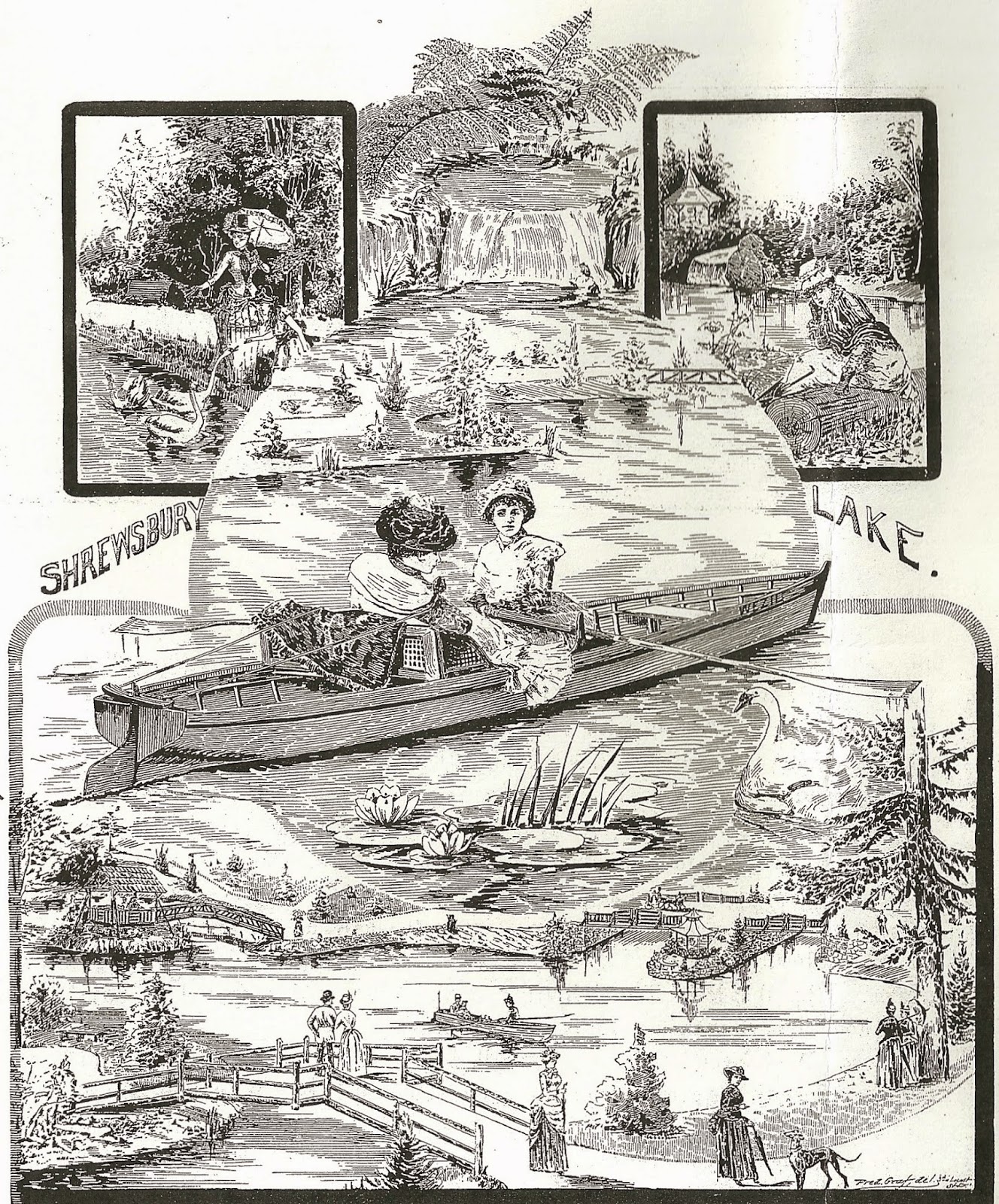
Shrewsbury Lake
The Shrewsbury Park Land and Improvement Company had gone to great lengths and expense to develop a community that would entice city dwellers to move to the country. Shrewsbury Park was laid out very much to resemble a park, complete with lakes, waterfalls, springs, spring houses, rustic bridges, pagodas and walkways.

As such, they put restrictions on what could and could not be built in the community in order to preserve the integrity of the design of the development. Within the deeds transferring ownership were the following provisions:

FIRST, Not to erect or permit to be erected, occupied or used on said property any livery stable, tannery, dram shop or saloon, slaughter house, public cattle shed, dairy, bone yard, glue factory nor any building or edifice designed or intended to be used for such purpose or purposes; and not to open or permit to be opened on said property any quarry or to establish any brickyard or any other similar businesses; also not to establish, maintain or permit any nuisance of any character on or adjacent to said property, and not to erect any building on said property to cost less than Fifteen Hundred (1500) Dollars when finished.

SECOND, When a building is erected on said property the front of said building is to be not less than Twenty (20) feet distant from the line of the street on which said lot of ground fronts; but this provision shall not apply to the foundations of pillars or open porches or verandas which may be built upon the front of said residence.

THIRD, It shall be lawful for any other person or persons owning any lot or or part or parts of lots in any of the subdivisions of Shrewsbury Park, in behalf of and for the benefit pf either themselves or the said owner or owners, or for any or either of them to prosecute any proceeding or proceedings at law or in equity against a person or persons infringing or attempting to infringe, or omitting to perform or to keep, observe, or abide by said provision or provisions, for the purpose of preventing them from so doing, or collecting damage for such infringement or omission, or both.

Shrewsbury Park lawsuit
The third provision was invoked by two Shrewsbury Park residents, Charles H. Lillington and George H. Toehber, when they felt that some of their neighbors were in violation of the first provision. As this July 1, 1904 article in The St. Louis Republic states, the two men filed a petition with the St. Louis County Circuit Court requesting the the houses of nine of their neighbors be torn down due to violating the requirement that all buildings cost at least $1,500 to construct. Lillington and Toehber contended that the nine homes in question cost less than half that amount to build. The two men wanted these home either torn down or forced to comply with the $1,500 stipulation. The outcome of the lawsuit is unknown, but it must have made for an uncomfortable relationship between the men and their neighbors regardless of how the suit turned out.

"If you want to annoy your neighbors, tell the truth about them." ~ Pietro Arentino